TL;DR
- Five new roles this week, from Lightspeed and Moderna to a build-from-scratch M&A lead at Daisy
- AI as stated deal rationale fell from roughly one-third of top 2025 deals to 17% in 2026
- Three financial-services megadeals worth about $45B were announced in a single seven-week stretch this spring
- With Karp bashing token pricing and budgets blowing out, has the tokenmaxxing era peaked?
All content is written by me, with research pulled from online sources and AI. Sources are listed where possible. Some sections include photos and graphs generated to complement the articles.
This Week's Roles
This week's hand-picked roles across Corporate Development, Corporate Strategy, and Buyside M&A:
Senior Analyst, Corporate Development
Lightspeed
Exposure to the full deal lifecycle - sourcing through post-merger integration - at a dual-listed (TSX/NYSE) commerce platform. A solid entry point into Canadian tech corp dev at a company with a track record of acquisitions.
Head of Mergers and Acquisitions
Daisy
Build an acquisition function from scratch at an AI-native property management roll-up - already the 8th largest PM company in NYC. Rare for a Head of M&A role to come with direct CEO reporting and true greenfield scope.
M&A Corporate Development Associate
Farther
Drive practice acquisitions for a $15B AUM RIA disrupting wealth management, with hands-on exposure to sourcing, diligence, and deal structuring with retiring advisors. The RIA roll-up space is one of the more active M&A playgrounds running right now.
Director, Corporate Development & Strategy
Celanese
Serve as deal captain on Celanese's inorganic growth agenda - M&A, JV, and divestiture transactions end-to-end at a $10.3B specialty chemicals leader. A broad mandate that covers the full transaction lifecycle.
Senior Manager, Corporate Development
Moderna
Own Moderna's enterprise value model and long-range planning analytics, partnering across R&D, commercial, finance, and BD to shape board-level capital allocation decisions. A strategy-heavy corp dev seat with direct influence on how the company deploys capital.
AI is Losing its "Magic-Word" Status in Deal Rationale

If you've been reading M&A press releases for the past 18 months, the pattern feels obvious: cite AI in your deal announcement, watch the market applaud. PwC's analysis of the 100 largest corporate M&A transactions of 2025 backs that up - roughly one-third of them cited AI as part of the stated strategic rationale, and within the technology sector, nearly every top deal referenced it.
But the same analysis run six months later tells a different story. In the first half of 2026, only 17% of the largest deals cited AI as strategic rationale, concentrated almost entirely in technology, manufacturing, and power and utilities. AI hasn't lost relevance, and deal volumes in those adjacent sectors are still strong, but it's stopped being the default justification buyers reach for.
The shift tracks with a broader change in how capital allocators are behaving. General partners at leading PE firms are increasingly spending investment committee time evaluating whether portfolio companies can actually harness AI to boost productivity, or whether they're exposed to disruption if they don't. A target's "AI story" is being tested rather than taken at face value.
The 2025 wave of AI-cited megadeals is instructive here. Google's $32B acquisition of Wiz and Palo Alto Networks' $25B purchase of CyberArk were both framed around AI-adjacent capability, specifically the cybersecurity infrastructure needed to scale AI safely. Those were capability acquisitions with a clear AI thesis attached. What's disappearing in 2026 isn't deals like that, it's the reflexive "we're doing this because AI" framing on transactions where the underlying logic was really about scale, consolidation, or defense.
PwC frames the shift as buyers becoming more disciplined about where AI creates durable demand versus where it compresses value, and notably, where a partnership or minority stake might be the smarter move instead of a full acquisition. That's a meaningfully different posture than 2025's "acquire the capability" instinct.
Why This Matters for M&A Professionals
If you're building a business case for an AI-adjacent acquisition, "AI" is no longer a rationale on its own; it needs to survive the same scrutiny as any other capability thesis. Corp dev teams pitching AI targets internally should expect investment committees to probe durability and disruption risk specifically, not just growth potential.
Sources: PwC Global M&A Industry Trends 2026 Outlook (Jan 2026); PwC Global M&A Industry Trends Mid-Year 2026 Update (Jun 2026)
The Financial Services Sector is Quietly Consolidating
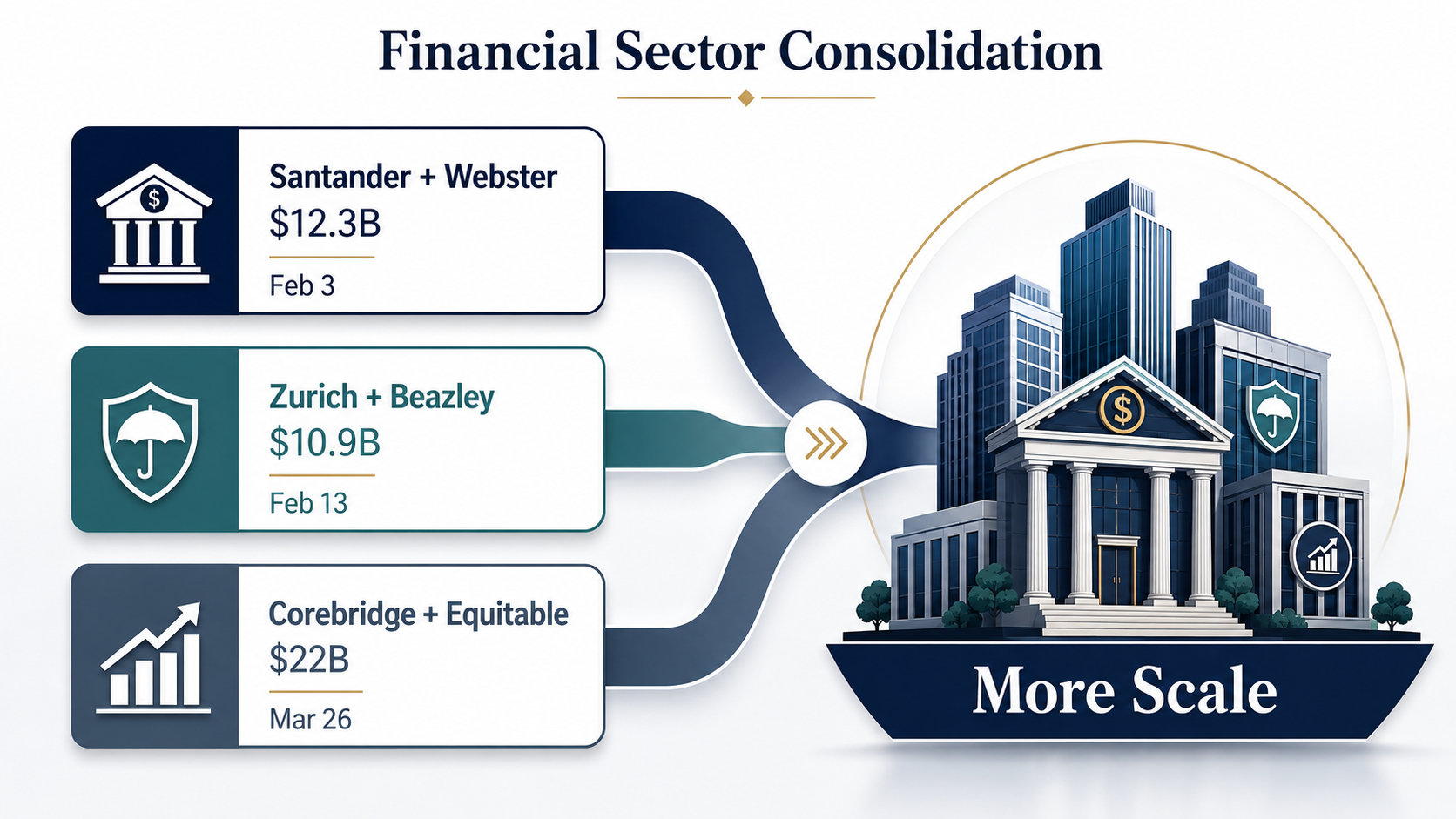
Between February 3 and March 26, 2026, the financial services sector saw three megadeals announced, worth a combined $45 billion. They all had the same underlying logic - scale is the strategy now, and the sector is racing to lock it in before conditions shift.
Banco Santander's $12.3 billion acquisition of Webster Financial was the first deal, announced on February 3rd. Webster stockholders get 2.0548 Santander ADSs per share, and $48.75 in cash - moving the total deal value past Webster's all-time high closing price. The combination creates a top-ten US commercial and retail bank by assets and a top-five bank by deposits in the Northeast, in a straightforward play for additional scale.
A few weeks later, Zurich Insurance agreed to buy UK specialty insurer Beazley for $10.9 billion, albeit with a less straightforward path forward. Prior to the deal announcement, Zurich had made several offers which Beazley's board rejected. These rejections were made public in January before Beazley finally accepted a sweetened bid, which Zurich financed with ~$3 billion in cash, ~$2.9 billion in new debt, and $5 billion from an accelerated bookbuild. The result is a UK-headquartered specialty insurance leader with roughly $15 billion in pro forma gross written premiums, built on Beazley's Lloyd's of London presence. Just a few weeks later, Zurich agreed to acquire Generali's Irish and Northern Irish P&C operations for €337 million, and has been running a pattern of smaller cyber-insuretech bolt-ons, like Boxx Insurance and Cowbell.
Finally, on March 26, Corebridge Financial and Equitable Holdings announced a $22 billion all-stock merger, structurally different than the preceding transactions (a new parent company combination), but with the same goal of increased scale. The result is a retirement, life, wealth, and asset management platform serving 12 million-plus customers with $1.5 trillion in combined AUM and administration.
Three different deal structures, three different sub-sectors, and all of them pre-close with targeted completion dates in H2 2026 or later, but with seemingly similar motivations for the synergies that come with scale.
Why This Matters for M&A Professionals
These aren't coordinated plays, but the timing suggests that financial services boards are concluding that scale beats standalone right now. These decisions became public all within the roughly seven-week timeframe. If you're in corp dev at a mid-sized financial provider, this is the environment you're competing in. The outcome of these transactions may be worth tracking, as all three are set to close in the second half of 2026 or early 2027.
Sources: Santander (Webster Financial press release, Feb 2026); Zurich Insurance Group (Beazley offer announcements, Feb–Apr 2026); Corebridge Financial / Equitable Holdings (merger announcement, Mar 2026); Insurance Journal (Apr 2026)
Is 'Tokenmaxxing' Over, and Have We Evolved Beyond the Learning Phase?

I was prompted to write about this after hearing Alex Karp criticize the standard token-revenue model currently being used by the major AI players like Anthropic and OpenAI. The issue isn't whether AI works. Its whether usage-based pricing still makes sense once companies move from experimentation to ROI discipline.
At the start of any major adoption there is always a period of acclimatization, where users need to figure out how to navigate new systems, tools, and processes before they can become truly efficient at using them. Naturally, this is a period of trial and error, where firms tend to overspend on the principle that investing in their workforce requires the spend today to unlock cost savings tomorrow.
It feels like we've been in this cycle ever since firms began adopting AI into their mandates, urging their employees to use AI at all costs to discover efficiencies and ways to increase their competitive edge.
This mindset incentivizes AI providers to adopt a model where users pay for spend - if they are going to be maximizing usage, why not charge them for that usage? Most of the major providers today are on a token-based revenue model, where a subscription buys you a certain number of tokens per month, and beyond that you can pay for additional tokens. Many of the enterprise contracts involving APIs are simply charged per token, meaning you pay for exactly what you use.
In recent months, there have been stories of firms realizing just how much their AI contracts are costing them. Microsoft, one of the most aggressive AI adopters in the market, is reportedly winding down internal Claude Code licenses across its Experiences and Devices division and moving those engineers onto its own GitHub Copilot CLI by June 30, the close of its fiscal year. The internal memo framed it as toolchain unification, but reporting points to cost as a major driver, with some reports stating that spend for AI-agents was exceeding the cost of some employee salaries.
Uber tells the story more starkly: it put Claude Code in front of roughly 5,000 engineers, watched usage climb to 84-95% by April, and reportedly burned through its annual AI budget in four months.
This isn't just a Microsoft or Uber problem. Enterprises are moving from 'tokenmaxxing' (burning as many tokens as possible) toward measurable ROI. Increasingly, firms are weighing the pros of AI against the cons, and in a twist, realizing these tools aren't always more efficient than the employees they're purported to replace.
I think Karp's worry is that if the major American AI-labs continue to employ token based pricing, in the long-term this could inhibit widespread adoption and force enterprise users to search for alternatives - building in-house or looking at foreign options. Worth noting his broadside landed two days after Palantir and Nvidia announced a sovereign-AI stack selling the exact self-hosted alternative he's recommending, so the critique doubles as a product pitch. But the concern stands: If Western firms begin shifting their contracts to foreign AI (and the biggest concern is always China), the implications on the American economy could be massive given the growth that is currently being underwritten in domestic AI infrastructure.
So the question is: have we really evolved beyond the learning phase? If the acclimatization period is ending and users are getting deliberate about where AI actually earns its cost, then pay-per-token starts to look less like the natural model and more like a holdover from the trial-and-error era it was built for.
Sources: CNBC Squawk Box (Jul 2026); The Verge (May 2026); Forbes (May 2026); Palantir/Nvidia (Jun 2026)
Thank You
Thanks for the support — it means a lot. Consider sharing with your network, or providing feedback here: corpdevcareers.com/contact
I post every Thursday. Subscribe to get the next issue delivered to your inbox.
— Liam