TL;DR
- 5 new Corp Dev and M&A roles this week, including Disney, Justworks, and Descartes
- The 2026 AI IPO wave may rival 2021's SPAC boom, but with far fewer companies absorbing far more capital
- Companies that banned ChatGPT in 2023 are now mandating AI use, as enterprise controls and model quality reshape the risk/reward tradeoff
All content is written by me, with research pulled from online sources and AI. Sources are listed where possible. Some sections include photos and graphs generated to complement the articles.
This Week's Roles
This week's hand-picked roles across Corporate Development, Corporate Strategy, and Buyside M&A:
Director, Strategy and Corporate Development
Justworks
Build out a combined Strategy and Corp Dev function at an HR-tech scale-up, with the mandate spanning M&A, investments, and partnerships alongside long-range planning. Three direct reports on day one - a rare structure for a Director-level role to come pre-built.
Senior Corporate Development Analyst
Lumen
Full-lifecycle analyst seat on the inorganic growth team at the telecom company, covering valuation, diligence, and maintaining a live trading and transaction comps database. One of this week's more accessible entry points for someone transitioning from banking or consulting into in-house corp dev.
Manager, Corporate Development
Disney
A seat on the roughly ten-person in-house M&A team behind Pixar, Marvel, Lucasfilm, and the Fox deal. MBA required, so this reads as a post-banking or post-PE landing spot rather than an early-career role.
AVP, Corporate Development
Co-operators
Senior national role at a Canadian financial services co-operative, running M&A execution plus oversight of an in-house corporate venture fund, reporting to the VP of Corporate Development and Capital Management. Ten-plus years and a CFA or CPA expected.
Director, Corporate Development
Descartes
Director-level deal role at a logistics-software serial acquirer that has closed more than 30 acquisitions and deployed over $1.4 billion in the past decade. Fully remote within Canada.
The 2026 AI IPO Wave vs. the 2021 SPAC Boom
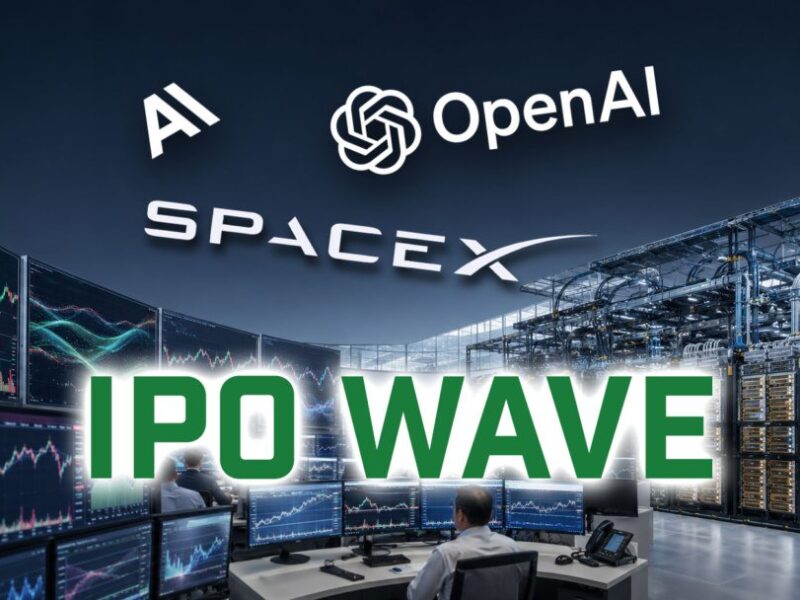
Anyone who worked on deals in 2020 and 2021 will remember it as an era of unprecedented listings. More than a thousand companies went public in the US in 2021 alone, an all-time record, and the engine behind the surge was the Special Purpose Acquisition Company (SPAC): the blank-check shell that raises money through an IPO first, and then finds a private company to merge with and take public.
Roughly 613 of that year's listings were SPACs, accounting for almost half of all IPO dollars. By year-end, about 82% of 2021's SPACs were still hunting for a target, and only around 3% had closed a deal.
Five years later, the IPO market is again approaching 2021-scale dollar figures, at least if the current pipeline prices as expected, but the structures could not be more dissimilar.
J.P. Morgan puts the 2021 US IPO peak above $275 billion, and 2026 is tracking above $250 billion. In fundraising terms, the AI IPO era now underway is within roughly 10% of the 2021 peak, but completely lacks the breadth that characterized - and arguably plagued - the SPAC boom.
Hyper-Concentration
Where 2021 spread its money across more than a thousand companies, 2026 concentrates it in a handful. SpaceX priced its June 12 listing to raise roughly $75 billion, the largest IPO in history.
Anthropic, the company behind Claude, filed confidentially on June 1, shortly after raising capital at a $965 billion post-money valuation, with OpenAI following about a week later (OpenAI was most recently valued at $852 billion on March 31).
If Anthropic and OpenAI raise at comparable mega-cap scale, these three companies alone could absorb north of $200 billion in investor capital. Compare this to 2025, where the US IPO market only raised about $45 billion all year. Concentration in 2026 is even greater when you consider that these three companies are not independent bets, but rather are all interconnected and priced with similar assumptions.
Where is the Money Coming From?
Two things are funding the current IPO rally. The first is idle cash: there's an estimated $8 trillion parked in US money market funds, held by households and institutions alike, so SpaceX's raise is about 1% of the pile - and the buyer base is unusually broad, with SpaceX routing more than 20% of its offering to retail versus the usual single digits.
The second is rotation: institutions have spent years buying AI by proxy - Nvidia for chips, Microsoft for its OpenAI stake, Alphabet for DeepMind and Anthropic - and when the pure-play labs list, the cash to buy them typically gets raised by selling something, like the existing Mag 7. This holds true for both retail and institutional investors. (Leverage is the third lever in theory, but the visible evidence points primarily to cash and rotation, not borrowed money.)
Retail buyers are usually shut out of hot listings - by one estimate, about 95% of a hot IPO's shares go to institutions - but SpaceX named retail brokerages directly in its filing as allocation channels, and the platforms moved to widen the door. Fidelity cut its IPO-access minimum to $2,000, from $500,000. Robinhood, SoFi and E*Trade required no minimum balance at all. In Canada, Wealthsimple opened offering-price access to ordinary users, a form of trading it said had been limited to high-net-worth investors until now. Reuters reported individuals were allocated about 30% of the SpaceX offering, against the roughly 10% usually reserved for retail in large listings. This was later reduced to just over 20% as institutional demand surged.
Why This Matters for M&A Professionals
The 2026 IPO wave may rival the 2021 SPAC boom in terms of dollars raised, but it will be defined by extreme concentration rather than historic breadth. For dealmakers, the pattern should feel familiar: private-market activity has also concentrated aggressively at the top, while overall volumes remain muted. That tension is striking, especially considering how many people, firms, and funds have spent the past few years trying to find businesses to buy.
Sources: Nasdaq (Jan 2022); Statista (2026); J.P. Morgan (May 2026); Reuters (Mar–Jun 2026); ICI (Jun 2026); Fortune (Jun 2026); TechCrunch (Jun 2026); CNBC (Jun 2026); BetaKit (Jun 2026).
From Banned to Mandated: The Three-Year Reversal
In the first half of 2023, a wave of large companies blocked their employees from using ChatGPT. Samsung banned generative AI tools on company devices after engineers uploaded confidential source code to the platform. Apple restricted ChatGPT and told staff not to use GitHub Copilot, over concerns about leaking confidential information. Goldman Sachs, Citigroup, and Bank of America blocked access through third-party software controls, and Verizon cut off access to ChatGPT across all business functions, citing the Samsung leak directly. JPMorgan and Deutsche Bank did the same. The logic was always similar: anything typed into a public model could become training data, with no contractual way to pull it back.
Three years later, these companies are mandating that their employees use generative AI - the same systems they banned.
Samsung is the cleanest example. This week the company opened ChatGPT Enterprise and Codex to all its Korea employees and its Device eXperience division worldwide - three years after restricting the tools over data-security concerns. Weekly active Codex users in Korea have grown nearly 800% since February 1, 2026.
JPMorgan went further. After blocking ChatGPT in 2023, it built LLM Suite, a proprietary platform now used across the firm. By March 2026, the bank had moved from permitting AI to setting explicit AI-use expectations for its roughly 65,000 engineers and technologists. Internal dashboards track usage frequency and classify employees as "light," "heavy," or "non" users, making AI adoption a visible management metric even if the bank says the data is not used directly as a performance-management input. The bank reported that engineers who adopted its internal coding assistant increased productivity by 10% to 20%.
The reversal wasn't just a change of heart about the risk. The 2023 bans were about preventing employees from feeding proprietary data into a public model that was trained on that data. By 2026, enterprise contracts generally prohibit company data from being used to further train the models, and the firms themselves control the use of data. Commercial agreements - ChatGPT Enterprise, Anthropic's business tier, governed API access - now carry no-training terms, data-retention controls, and admin-scoped permissions. JPMorgan's LLM Suite is model-agnostic, routing between OpenAI and Anthropic models behind the bank's own perimeter, so employees never paste firm data into a public website. The risk of data breaches didn't disappear, but there are more controls giving these firms comfort today than there were in 2023.
On top of that, the tools got too good to sit out on. The gap between models from 2023 to 2026 is enormous. Stanford's 2026 AI index found frontier models gained 30 percentage points in a single year on one expert-level benchmark. At the current growth pace, a blanket ban stopped being a prudent control and became a competitive handicap.
Why This Matters for M&A Professionals
The exact data that got these tools banned in 2023 - confidential code, deal documents, client information - is what a corp dev team handles every day. The data-leakage risk that concerns these firms is perhaps most concentrated in corp dev teams, but so are the benefits that come from using generative AI.
Sources: Fortune (May 2023); Semafor (May 2023); Artificial Intelligence News (June 2026); Business Insider (March 2026); Emerj (March 2026); Stanford HAI 2026 AI Index (April 2026); McKinsey Global Survey on AI (May 2024, March 2025).
Thank You
Thanks for the support — it means a lot. Consider sharing with your network, or providing feedback here: corpdevcareers.com/contact
I post every Thursday. Subscribe to get the next issue delivered to your inbox.
— Liam