TL;DR
- 5 new Corp Dev and M&A roles this week, including Suntory Global Spirits and Transamerica
- Anthropic: Claude's newest frontier model was pulled after three days, turning AI model access into a real vendor-risk issue for teams relying on frontier tools
- SpaceX / Cursor: SpaceX's $60B Cursor deal shows how newly public equity can become acquisition currency - and how messy AI co-opetition is getting
All content is written by me, with research pulled from online sources and AI. Sources are listed where possible. Some sections include photos and graphs generated to complement the articles.
This Week's Roles
This week's hand-picked roles across Corporate Development, Corporate Strategy, and Buyside M&A:
Associate, Corporate Development
Tenstorrent
Sit at the center of a fast-scaling RISC-V and AI compute company, working directly with the C-suite across M&A, fundraising, partnerships, and corporate strategy. Seniority is calibrated during interviews, so it is open to a range of experience levels.
Manager, Corporate Development
Suntory Global Spirits
Join the global Corp Dev and Strategy team at the world's third-largest premium spirits company, working on acquisitions, divestitures, minority investments, JVs, and partnerships. Targets 2–4 years from banking, PE, consulting, or in-house corp dev.
Senior Director, Corporate Development
Wiley
A senior in-house dealmaker reporting to the Head of Corp Dev, owning the full M&A lifecycle as Wiley pushes deeper into AI, content, and data-services acquisitions. Looking for 8–10+ years across banking, PE, VC, or corp dev.
Director, Corporate Development
Transamerica
Lead inorganic growth across M&A, reinsurance, and strategic partnerships at the Aegon-owned insurance and retirement giant, with a Corp Dev team to build and manage. The job family is Mergers and Acquisitions; 10+ years required.
Senior Director, Corporate Development
GlobalFoundries
Run the full transaction lifecycle in semiconductor M&A at one of the world's largest chip foundries, partnering with Product Line leaders on build/buy/partner decisions and target selection. Fully remote in the US, 10+ years in M&A required.
The Anthropic Legal Saga Continues
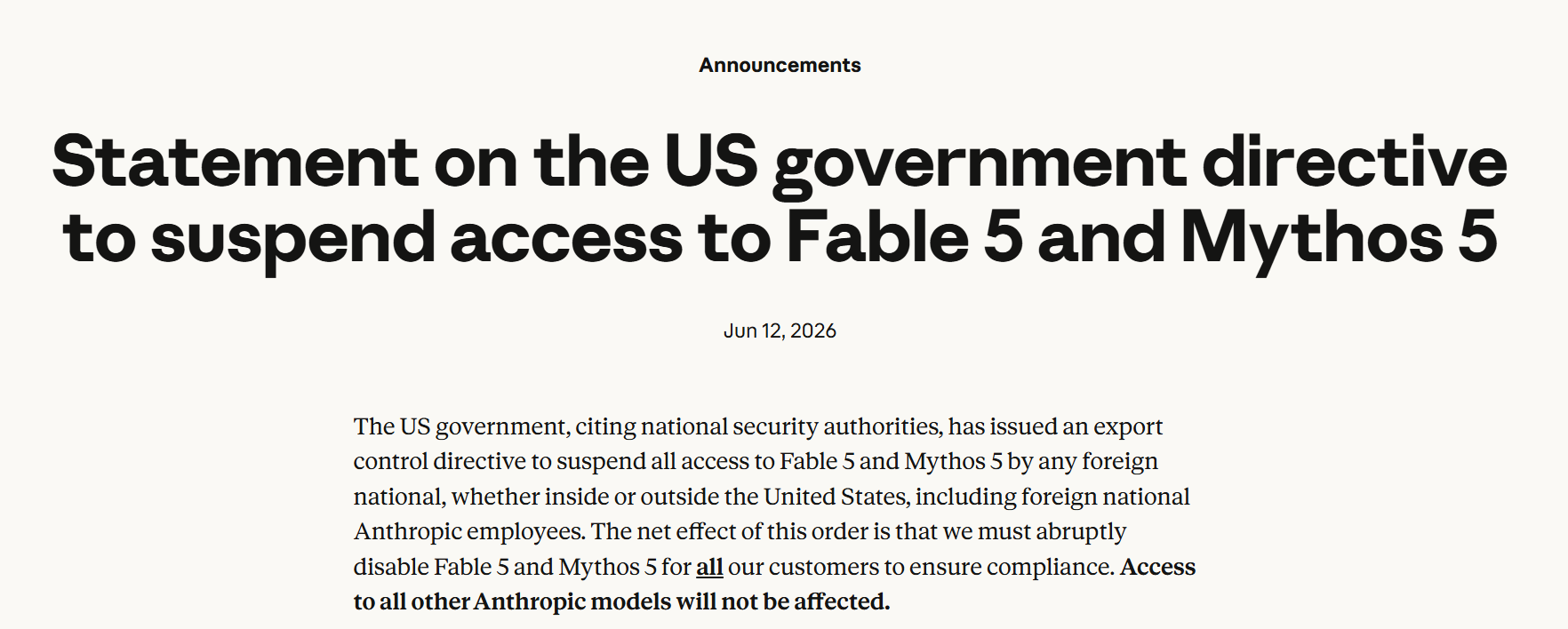
Claude's Newest Frontier Model Lasted Three Days
We recently spoke about Anthropic's release of Fable 5 to the general public - their most powerful available model to date. Three days after its release, the company put it back on the shelf, and customers are back to using their lower tier offerings. Here's what happened, and why it matters for anyone building workflows around frontier AI.
Fable 5, released on June 9, is the general-use version of Anthropic's Mythos-class model. It featured guardrails to reroute "high-risk" requests to a lower tier model, to reduce access to higher-risk cyber and bio capabilities. Three days later, CEO Dario Amodei received a letter from the Commerce Secretary Howard Lutnick placing both models under export controls, citing national security authorities and ordering Anthropic to cut off access for any foreign national anywhere, including Anthropic's own non-citizen employees.
The Impact
The company disabled both models for everyone to ensure compliance. The practical problem was segmentation: there is no reliable way to separate non-citizens from US citizens in real time across a user base in the hundreds of millions, especially on same-day notice, so a blanket shutdown was the only fast route to compliance. Opus 4.8, Sonnet and Haiku were untouched.
But what prompted the US government to initiate this action? Their concern, as Anthropic understands it, was a method of "jailbreaking" Fable's safeguards. Jailbreaking, in this context, means finding a way of getting an AI model to ignore or work around its security guardrails, allowing users to gain access to a less encumbered version of the model.
Anthropic reviewed the demonstration but disagrees with the decision, stating that this same technique is widely available to all other models including OpenAI's GPT-5.5, and is used every day by defenders who keep systems safe. They are complying, but are working to restore access.
This Isn't an Isolated Event
Anthropic has faced a series of challenges from the US government, beginning in early March when the DoD designated Anthropic a "supply chain risk" - the first time the label was applied to a US company. The designation reportedly followed Anthropic's refusal to allow Claude to be used by the US government for autonomous weapons or domestic surveillance. Anthropic sued, and in early April a federal judge granted a preliminary injunction, finding the motive was likely "unlawful retaliation", though the designation remains in effect pending litigation.
In the present battle, Anthropic has received support from more than 80 CEOs, executive directors, and security engineers, who signed a letter asking Lutnick to lift the directive, arguing that it has barred cyber defenders from accessing advanced AI tools.
Why This Matters for M&A Professionals
If your diligence, integration or research workflows lean on a single frontier model, its availability is now a vendor-risk variable, not a given. Consider a fallback option before you need one.
Sources: Anthropic (June 2026); Axios (June 2026); MobiHealthNews (June 2026); Snyk (June 2026); CNBC (February–June 2026); NPR (March 2026); Breaking Defense (April 2026); Fortune (June 2026).
The timing matters for one more reason. Anthropic filed a confidential S-1 with the SEC on June 1, days after a private round valued it near $965 billion, though the IPO price itself is not yet set. The Fable incident provides investors with another risk that is difficult to price. The more capable these models get, the more government scrutiny they draw, and evidently this scrutiny can lead to complications.
SpaceX to Acquire Anysphere (Cursor)
With SpaceX's record-setting IPO monopolizing the headlines, it would have been easy to miss the other major move: a merger between SpaceX and Cursor's parent company, Anysphere. Just days after the IPO was completed, Musk agreed to pay $60 billion in stock for the coding tool - likely a move to get closer to true competition with Anthropic and OpenAI.
Cursor is an AI coding assistant: software that helps users write, edit, and review code by generating it from plain-language instructions in real time. It's a direct competitor to Anthropic's Claude Code, but unlike Claude Code, Cursor is AI model-agnostic, meaning it runs on Anthropic, OpenAI, and its own Composer models simultaneously. Its ability to switch between models has been part of what makes it appealing, and operates similarly to how Perplexity lets you choose which model answers.
Per a SEC filing, SpaceX signed the merger agreement on June 16, with subsidiary X67 Inc. merging into Anysphere in an all-stock deal expected to close in Q3 2026. It's a hefty price tag, but Cursor crossed $1 billion in annualized revenue last November and now runs close to $2.6 billion, per Reuters.
It also helps that this is an all-stock deal, struck immediately after an IPO that raised more than $80 billion and has since left SpaceX with a valuation above $2 trillion.
The Co-opetition Question
There are some nuances to this deal that raise some questions. Back in May, the same SpaceX AI unit leased its flagship Colossus 1 supercomputer to Anthropic, a direct competitor, in a roughly four-year deal worth a reported $5 to $6 billion a year (New Street puts it lower, $3–4 billion). In a previous article, we discussed how Colossus 1 was left running at only ~11% utilization, after xAI shifted its main workloads to Colossus 2.
As we mentioned before, Cursor is model-agnostic - for the time being. SpaceX has said that it plans to ship its own model on Cursor, which has already spent months under joint training. Musk is currently monetizing the idle compute of Colossus 1, but the question remains: if Cursor needs more compute, will Musk look to reclaim the valuable real estate currently being leased by his direct competitor, Anthropic?
Why This Matters for M&A Professionals
There are a couple reads here. First, we're seeing that Musk has no qualms spending SpaceX's newly liquid public equity as acquisition currency, and indeed the window right after a major liquidity event is when stock is most spendable. SpaceX started spending theirs within days.
Second is the co-opetition structure around Colossus 1. SpaceX is now simultaneously Anthropic's landlord, a distribution channel for Claude, and a direct competitor. These overlapping interests are the exact kind of conflicts that corp dev teams get paid to map during diligence.
Sources: SEC filing via Reuters (June 2026); CNBC (June 2026); Data Center Dynamics (May 2026); Fortune / New Street Research (May 2026).
Thank You
Thanks for the support — it means a lot. Consider sharing with your network, or providing feedback here: corpdevcareers.com/contact
I post every Thursday. Subscribe to get the next issue delivered to your inbox.
— Liam