TL;DR
- 5 new Corp Dev and M&A roles this week, including Klaviyo and Canada Life
- GPT-5.5 vs. Claude Opus 4.7: where each model actually wins
- Why political fragmentation is reshaping cross-border M&A
- Liam's Take: the rise of the VMS corp dev career path
All content is written by me, with research pulled from online sources and AI. Sources are listed where possible. Some sections include photos and graphs generated to complement the articles.
This Week's Roles
This week's hand-picked roles across Corporate Development, Corporate Strategy, and Buyside M&A:
Corporate Development Analyst (M&A)
Geotab
Analyst seat at Canada's connected-vehicle leader, supporting M&A target identification, financial modeling, and Investment Committee materials. Strong public salary band, deep cross-functional exposure across Legal, Finance, and Engineering.
Director, Corporate Development
Canada Life (Great-West Lifeco)
Senior in-house seat at one of Canada's largest insurers, owning M&A, divestitures, JVs, and partnerships across Lifeco's insurance, wealth, and retirement businesses. Reports to VP, Corporate Development.
Manager, Strategy and M&A
ATS Corporation
Hybrid strategy and deal-execution role inside the $1.5B ATS Life Sciences Group, supporting acquisition mandates and portfolio strategy. Reports to Director, Strategy and M&A; partners directly with the Corporate Development team on transactions.
Corporate Development Associate (M&A Business Development)
Aspire Software (Valsoft)
Front-line sourcing role at one of the most active VMS consolidators globally (150+ acquisitions across 20+ countries since 2015). Heavy founder outreach, pipeline ownership, and early-stage target evaluation. Strong fit for anyone wanting to break into the Constellation-style roll-up world.
Head of Corporate Development
Klaviyo
Senior leadership seat owning Klaviyo's inorganic growth strategy end-to-end, from pipeline to integration. Reports into the leadership team; primary deal lead alongside CEO, CPO, and CFO. 12+ years of deal experience required.
GPT-5.5 vs. Claude Opus 4.7: When to Use the Frontier Models
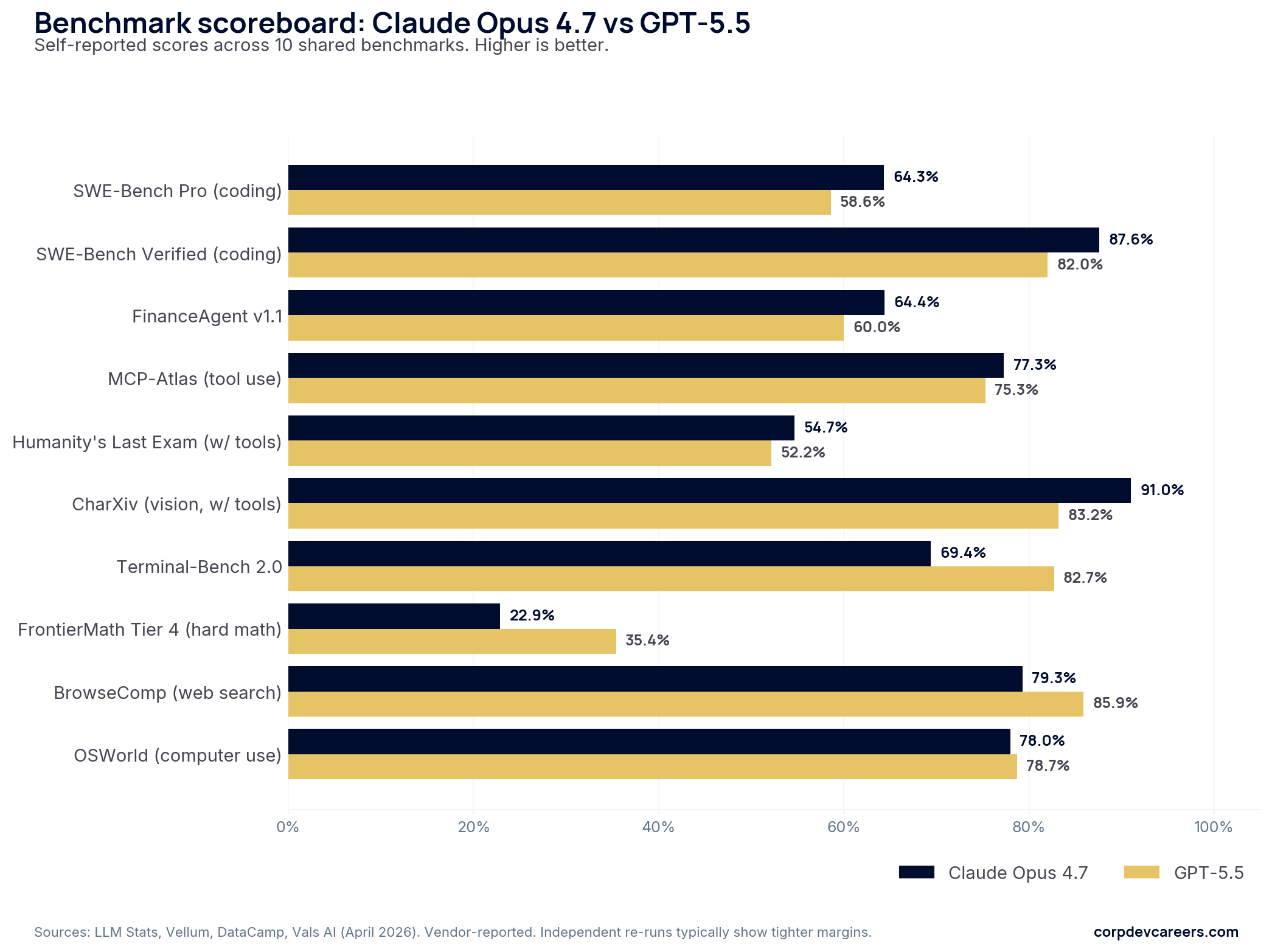
In April, two of the major AI companies, OpenAI and Anthropic, shipped new frontier models a week apart.
The Headline Numbers
Benchmarks are standardized tests that measure how well an AI model performs on a specific task, with each test designed to probe a different capability (document analysis, coding, math, etc.).
Across the ten benchmarks both providers report, results were fairly evenly split, with Opus 4.7 leading on six, and GPT-5.5 leading on four. It's important to note that these numbers are vendor-reported, and can be off slightly from independently-run tests.
Opus 4.7 leads on:
- Coding (the two SWE-Bench tests, which measure how well a model fixes real bugs in real codebases): 64.3% vs 58.6% on the harder version, 87.6% vs ~82% on the standard one
- Hard reasoning questions (Humanity's Last Exam, a benchmark of PhD-level questions across every field): wins both with and without tools
- Juggling multiple tools at once (MCP-Atlas): 77.3% vs 75.3%
- Finance work (FinanceAgent, which tests analyst-style tasks like document review and modeling): 64.4% vs ~60%
- Reading charts and visuals (CharXiv): processes images at 3.3x the resolution, which matters for dense pitch decks and financial statements
GPT-5.5 leads on:
- Running terminal commands and DevOps work (Terminal-Bench): 82.7% vs 69.4%, the biggest gap in either direction
- The hardest math problems (FrontierMath, research-level math): 35.4% vs 22.9%
- Web search and live browsing (BrowseComp)
- Reading very long documents (past 500K tokens, roughly a 1,000-page document): stays sharp where Opus starts to slow down and gets more expensive
- Cost efficiency: produces substantially fewer output tokens than Opus on equivalent tasks, making it meaningfully cheaper per task at scale
Memory, or Hallucination?
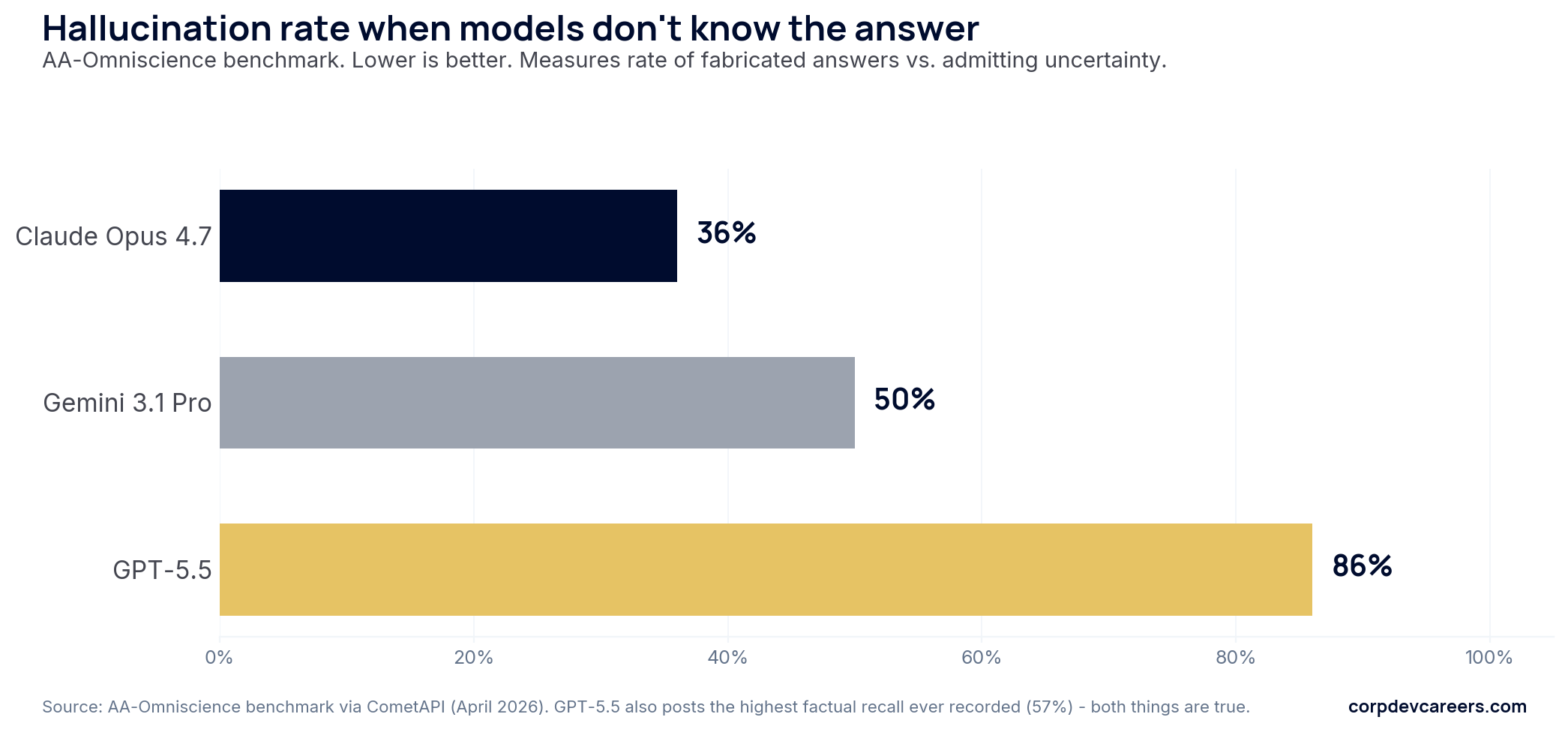
In a previous article, we discussed how AI can sometimes make up answers, or "hallucinate" when it does not know the correct response to give. This is one of the reasons it's important to keep a human in the loop when AI is being used to generate reports, calculations, or output.
The hallucination percentage measures how often a model makes up an answer when it doesn't know, rather than admitting uncertainty. In the cited hallucination evaluations, Opus fabricated a response 36% of the time, versus 86% for GPT-5.5.
But there's a trade off — while GPT-5.5 was found to hallucinate more than Opus, it was also found to have the highest factual recall ever recorded among publicly reported evaluations, at 57%. In other words, GPT-5.5 is most likely to make up a response when it doesn't know the answer, but it is also, statistically speaking, the model most likely to KNOW the answer.
How Practitioners Are Using Them
A pattern showing up in developer communities — one that we've discussed previously — is that people are increasingly using multiple models in tandem.
Knowing when to use which model can be difficult, but is beneficial for maximizing work output and minimizing mistakes. For example, GPT-5.5 is better at long-context input, meaning the ability to read and scan long (1,000-page+) documents without losing track or breaking down, but Opus is generally better at long-form output, the ability to write long memos from scratch while maintaining clarity and stylistic consistency.
Sources: LLM Stats (April 2026); Vellum (April 2026); DataCamp (April 2026); Vals AI FinanceAgent v1.1 (April 2026); Tom's Guide (April 2026); CometAPI (April 2026); Attainment Labs (April 2026).
Editor's Note
The factual recall vs. hallucination story is pretty interesting for anyone looking to dig deeper. Factual recall is tested by asking a model a series of questions with definite, verifiable answers. The percentage measures right versus wrong, as if it were taking a math test.
Hallucination rate is a measure of a model's willingness to fabricate an answer rather than admit it doesn't know. It's like getting a wrong answer on a math test by using the wrong equation, instead of leaving the question blank when you don't know.
M&A Defies the Global Order

When You Can't Export, Acquire
The modern political backdrop seems increasingly hostile towards the post-Cold War consensus on open markets. The Trump tariff regime announced in April 2025 is now over a year old. The EU is rewriting merger guidelines around "competitiveness and resilience". Foreign investment screening has tightened in many major jurisdictions.
By almost every political indicator, the world appears to be entering a period of anti-globalization.
But cross-border M&A isn't just retreating as you might expect; it's being rerouted. It's like dropping a boulder into a moving river — the water still flows, it just finds a new path. Companies that used to access foreign markets via trade are now finding creative ways to access the same markets, via acquisition. Similarly, companies that have typically relied on US infrastructure are increasingly exploring sovereign alternatives via cross-border consolidation.
A few recent deals help make the pattern visible:
Sun Pharma's $11.75 billion all-cash buyout of Organon (announced April 26) is the largest overseas acquisition by an Indian pharmaceutical company on record. Sun is paying a 24% premium over Organon's prior close and roughly 60% over the price before takeover interest leaked in mid-January. The fact that exporting into the US has gotten harder didn't kill the deal, and if anything made buying Organon the cleaner path.
Nippon Steel's $14.9 billion acquisition of US Steel finally closed in June 2025 after a multi-year political battle that included a national security review, a presidential block, and ultimately a security agreement giving the US government a "golden share." The deal is the textbook case of buying inside the tariff wall — when exporting steel into the US becomes structurally harder, the alternative is owning US production.
Cohere and Aleph Alpha announced a transatlantic combination effort on April 24 aimed at building sovereign AI alternatives for European institutions. It was endorsed at the Berlin announcement by both the Canadian and the German digital ministers, and the deal logic is explicitly geopolitical. It's an alternative to OpenAI and Anthropic for European institutions that don't want their data on US infrastructure. Sovereign AI initiatives are increasingly being driven by geopolitical fragmentation and data-localization concerns.
Why This Matters for M&A Strategy
Acquisition for access has always been part of the playbook, but in light of recent political movements, it's shifting from a bonus rationale to the core driver. Domestic acquirers are increasingly being outbid and surprised by foreign strategics whose models include things that purely domestic comps don't capture. Until local valuation models treat access as a primary driver, teams will systematically underestimate what a more motivated bidder will pay.
Sources: S&P Global (Apr 2026); PwC Global M&A Trends 2026; Organon 8-K (Apr 2026); Bloomberg (Apr 2026); FiercePharma (Apr 2026); TechCrunch (Apr 2026); CNBC (Apr 2026); Tech.eu (Apr 2026).
The Rise of the VMS Corp Dev Career

When I first started my career in M&A, it was at Constellation Software (TSX: CSU), a vertical market software (VMS) serial acquirer. At that time, most of my friends and peers still thought Constellation was either a soft drink company or some kind of astrology business, despite it being one of the largest tech companies on the TSX.
Fast forward to today, and Constellation is almost a household name within M&A circles. After over a thousand completed acquisitions, the company has built one of the most recognizable software acquisition machines in the world, with hundreds of employees focused on business development and M&A execution.
In many ways, Constellation helped to form the modern identity of the business development function, with its distinctive use of dedicated outreach specialists. If you're a software business owner, you've likely been reached out to directly by someone at Constellation.
The model was almost too effective not to copy. Buy profitable niche software companies, and hold them indefinitely. No chasing aggressive growth, or seeking unrealistic synergies, just maintaining brands and servicing their core group of clients.
Over the past ten years, we've seen a number of firms established with a similar purpose — Valsoft, Banyan, Arcadea, and others — all competing for similar software companies.
To fuel this competition, these firms all rely on outbound business development, and there's a real market for skilled corporate development professionals who can successfully get owner operators on the phone, open to a conversation about selling.
Whatever happens to the traditional SaaS business in an AI-disrupted world, the buy-and-hold consolidator model isn't going anywhere — and the business development function is now one of the more underrated and interesting career paths in M&A. If you're early in your career and looking at M&A, the BD seat at a serial acquirer is worth understanding, and the skills it teaches — sourcing, founder outreach, negotiation — translate almost anywhere else in M&A.
Thank You
Thanks for the support — it means a lot. Consider sharing with your network, or providing feedback here: corpdevcareers.com/contact
I post every Thursday. Subscribe to get the next issue delivered to your inbox.
— Liam